
Tempo Therapeutics develops scaffolds for reconstructing irregular surgical wounds
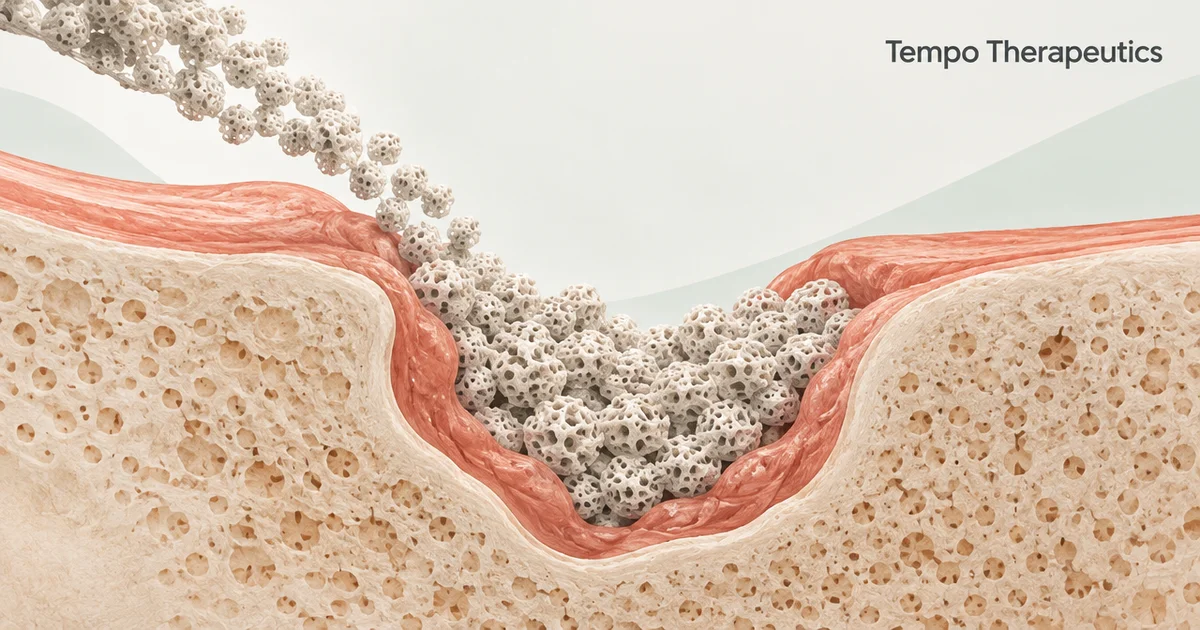
Tempo Therapeutics is developing a flowable synthetic scaffold intended to help surgeons reconstruct tissue after surgery. Its material is designed to fit irregular wounds, where a scaffold that conforms to the space could be useful for reconstruction.
A material shaped around the wound
The clinical-stage company calls its platform Microporous Annealed Particle, or MAP. Its lead material, TT101, contains no cells or biological factors. Instead, the porous material is designed to provide a temporary structure into which cells and blood vessels can grow as tissue forms.
A surgeon could encounter the need for reconstruction after removing skin cancer, when the remaining wound may have an uneven shape or expose underlying structures. Tempo’s approach puts the material’s physical architecture at the center of its product: it can flow into a space rather than relying on a pre-shaped implant.
From initial safety to reconstruction
Tempo’s first-in-human study examined wounds left after Mohs surgery for non-melanoma skin cancer. The randomized study assigned 26 patients to the MAP wound matrix and 14 to a hydrocolloid dressing. Its primary endpoint was safety.