
Adiabatic Machines bets on cold chips to tackle AI’s power problem
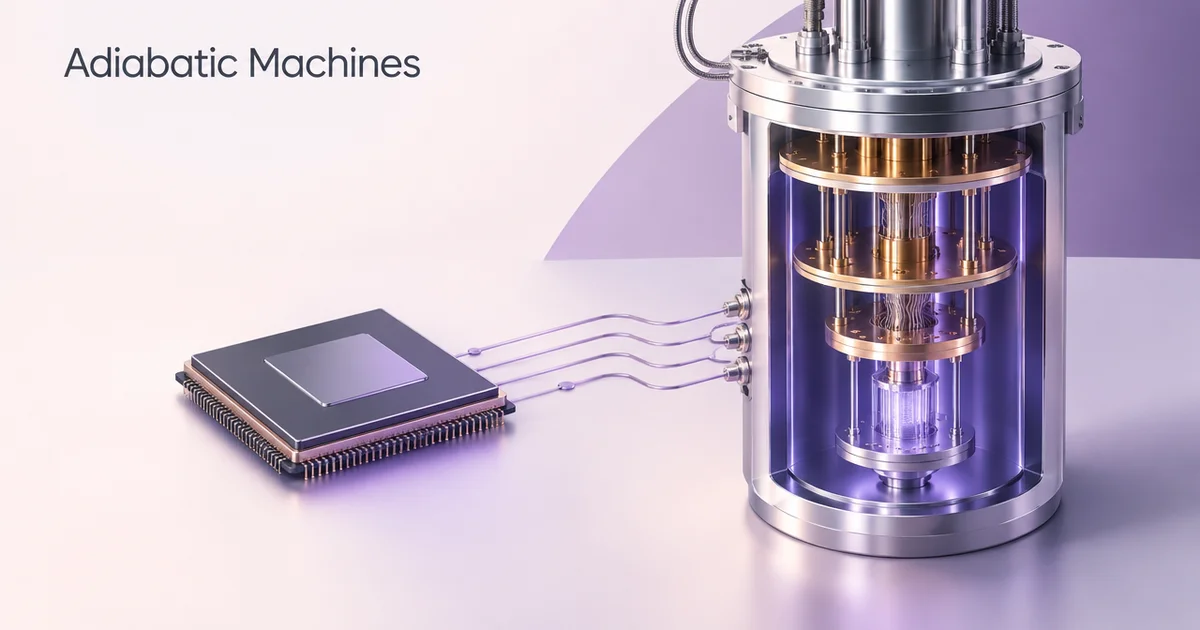
Adiabatic Machines is developing a processor for AI inference, the work of running a trained model, that would operate at just 4 kelvin inside a refrigerator. Its premise is that superconducting circuits could waste less energy during computation, even after accounting for the power needed to keep them cold. For a data-center operator, a processor that delivers more useful work per unit of total power could make constrained electricity capacity go further. The commercial question is whether the complete system, cooling included, can deliver that advantage on real workloads.
A model before a machine
The company’s current demonstration is an invitation-only digital twin: a computer model that executes the matrix arithmetic of a language model. Adiabatic Machines says the model is calibrated against fabricated superconducting circuits. It is a research demonstration, not a shipped processor.
The power bill includes cooling
The design uses an alternating-current clock to reshape the energy landscape of its logic gates. Superconducting connections are intended to carry signals with little energy loss. The company also intends the processor to run standard AI models using existing software tools, without retraining.
That software goal matters commercially: if it works, an operator could adopt different hardware without rebuilding every model around it. The cooling system, however, has to be counted alongside the chip when comparing the electricity needed for a workload.
The opportunity sits within a substantial electricity market, although aggregate data-center consumption is not a measure of demand for this company. Lawrence Berkeley National Laboratory estimated that U.S. data centers used 192 terawatt-hours in 2024, or 4.7% of national electricity consumption.